Recent news coverage has caused many people to search for information about hantavirus and whether it is a concern in Illinois. While hantavirus infections are extremely rare in the Midwest compared to western states, deer mice in Northern Illinois can carry strains of hantavirus, making proper rodent control and cleanup important for homeowners.
Understanding how hantavirus spreads, where deer mice live, and how to safely clean rodent-contaminated areas can help reduce unnecessary fear while still taking reasonable precautions,
What is Hantavirus?
Hantaviruses are a group of viruses carried by certain wild rodents. It is named after the Hantaan region of Korea where it was first identified as a unique disease during the Korean War, but strains have existed worldwide for millennia. In North America, the primary carrier is the deer mouse (Peromyscus manicalatus), a common rodent found throughout much of the United States, including Illinois.
People can become exposed when virus particles from rodent urine, droppings, or nesting materials become airborne and are inhaled. This most commonly happens while cleaning enclosed areas with long-term rodent activity.
Although hantavirus receives significant media attention during outbreaks, confirmed human cases remain very uncommon because most strains cannot transmit person to person.
Are there Hantavirus cases in Illinois?
Hantavirus infections in Illinois are very rare. Since tracking started in 1993, no more than 7 cases have been documented and confirmed. As of May 12 2026, a Winnebago resident is suspected to have come down with the North American strain of Hantavirus, but is still unconfirmed. There has only ever been one death attributed to Hantavirus in Illinois, back in 1996.
Confirmed cases in the United States tend to occur in western states such as New Mexico, Colorado, Arizona, and California. This region is where the North American strains of Hantavirus were discovered in 1993, after a particularly rainy El Niño season. Huge vegetation growth brought on by the flooding led to a 10-20x increase in local rodent populations. This increased rodent-human contact significantly and lead to a cluster of cases that eventually drew the attention of the CDC and led to the discovery.
How does Hantavirus Spread?
Hantavirus does not spread through casual contact with rodents alone. The primary concern is inhaling contaminated dust particles during cleanup activities.
Higher-risk situations can include:
- Sweeping mouse droppings
- Vacuuming droppings (without a HEPA filter especially)
- Cleaning enclosed sheds or cabins
- Disturbing old nesting material
- Working in attics or crawlspaces with heavy rodent activity
Fresh air circulation and proper cleanup methods greatly reduce risk.
What do Deer Mice look like?
Deer mice are much more common in rural and semi-rural areas of Northern Illinois than many homeowners realize. Deer mice are often confused with common house mice, but there are several important differences.
Deer mice typically have:
- White undersides and feet
- Brown or gray backs
- Larger eyes and ears
- Sharply bi-colored tail
House mice are usually more uniformly gray or dusty brown and are more strongly associated with indoor infestations.
In Northern Illinois, deer mice are more commonly encountered in garages, sheds, crawlspaces, and rural properties rather than heavily urban environments. They are often encountered during cooler weather when outdoor food becomes scarcer and rodents begin entering sheds, garages, crawlspaces, and seasonal structures for shelter.
Learn more about the differences of Deer Mice to Field Mice and other rodents
How to safely clean mouse droppings
One of the biggest mistakes homeowners make is dry sweeping or vacuuming mouse droppings improperly. Any time you are dealing with rodent droppings, be sure to follow the following precautions:
- Wear gloves and an N95 (or higher) respirator when dealing with significant contamination
- Spray droppings and nesting materials with disinfectant before removal
- Wipe up material with moistened paper towels rather than sweeping
- If vacuuming, only use a HEPA-rated vacuum
- Dispose of waste in sealed bags
- Wash hands thoroughly after
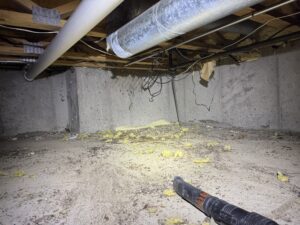
For severe infestations, especially when dealing with infestations in confined areas like attics and crawlspaces where insulation is contaminated, professional cleanup is recommended.
Should Northern Illinois/Midwest homeowners be concerned?
While hantavirus is not something most Illinois homeowners are likely to encounter, precautions are very important when dealing with droppings due to the various irritants and bacteria they carry. Mice can also contaminate food, damage insulation, chew wiring, and create sanitation concerns.
The CDC notes that the Andes strain found in South America is the only hantavirus associated with person-to-person transmission. The strains associated with deer mice in North America and other parts of the world are not believed to spread this way.
In short, take proper precautions when handling rodent droppings no matter what.
Professional Rodent Control in Northern Illinois
At Fox Valley Environmental Pest Control, we help homeowners throughout Kane County, DuPage County, and surrounding Northern Illinois communities identify rodent entry points, control infestations, and safely address contaminated areas. Proper exclusion and long-term rodent prevention are often far more effective than relying on traps or poison alone.
We handle rodent control, dropping cleanup, rodent exclusion, and insulation replacement and repair.